
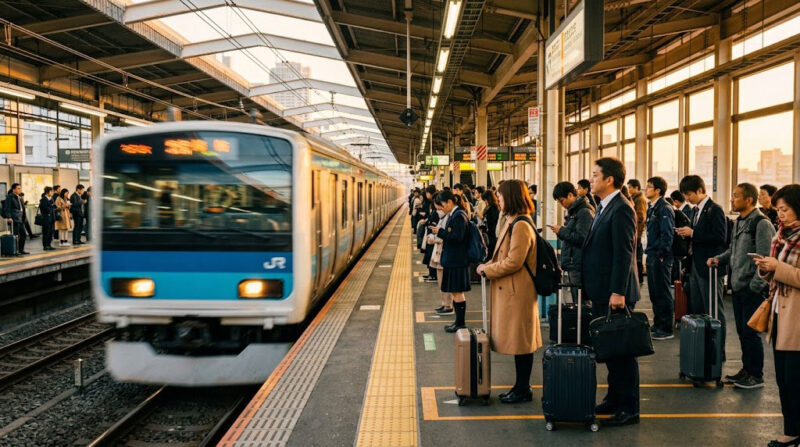
Japanese cities are surprisingly easy to navigate in English, and the Shinkansen connects nearly every major city. Here’s a guide on how to get around Japan.

Takkyubin: Japan’s magical luggage forwarding service
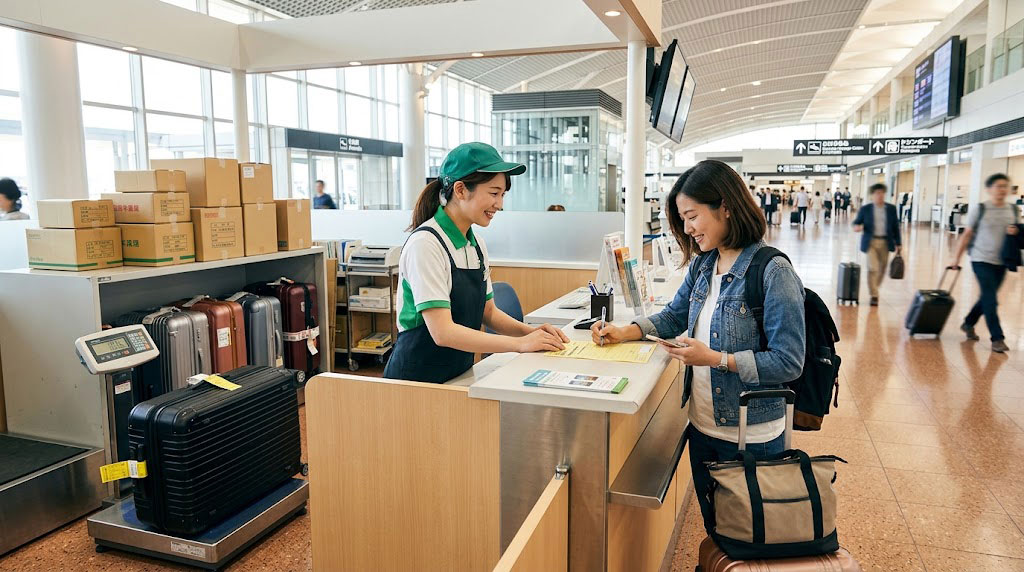
If you can manage it, pack a travel backpack, not a rolling suitcase. Japan’s trains, station stairs, and narrow hotel elevators weren’t built with giant luggage in mind, and a bag on your back beats one you’re dragging through the street every time. That said, if you’re bringing a large suitcase, or you end up buying something bulky partway through the trip, takkyubin luggage forwarding is worth knowing about.
send your suitcase ahead
Yamato Transport, easy to spot by its black cat logo, will move a suitcase between hotels or even to the airport for about ¥1,500 to ¥2,500 a bag.
All hotels and many shops offer takkyubin – just ask for a form at the guest counter. Packing warm layers for a few days of skiing in Hokkaido that you won’t need in Tokyo or Kyoto? Send that bag ahead to meet you there instead of carrying it for the whole trip. Bought a knife in Kappabashi or a ceramic set in Kyoto and don’t want to haul it through two more cities before you fly home? Send it straight to your last hotel or to the Yamato Transport counter at the airport – you can schedule a delivery up to two weeks in advance.
Note that takkyubin is a next-day service. Check out of your hotel in the morning, and your suitcase typically arrives at your next hotel the following day (repeat: not same day), usually sometime in the afternoon. That means whatever you’re carrying with you needs at least one full day’s worth of essentials: travel-size toiletries and a change of clothes, at minimum.
The Shinkansen
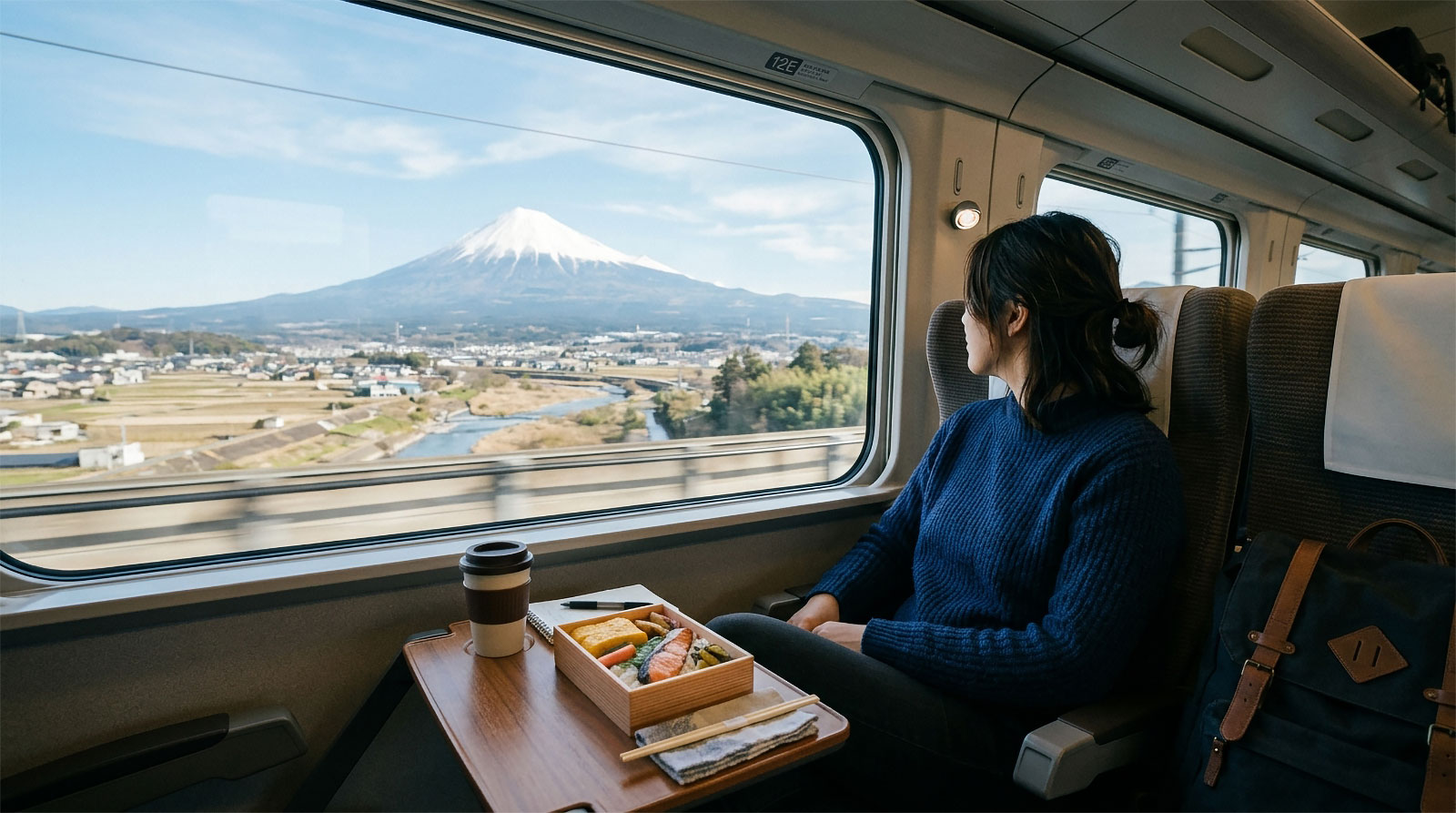
The bullet train is one of the highlights of any trip to Japan. It’s an easy choice over flying – at peak times there are train departures every few minutes, and the trains are clean, quiet, and comfortable.
view Mt. Fuji from the train
For Tokyo → Kyoto/Osaka, Mt. Fuji is on the right-hand side of the train. In an Ordinary Car, Seat E is the window seat with the best Fuji view. In Green Car, it’s Seat D. Mt. Fuji becomes visible (if the weather is clear) right around Shin-Fuji Station, about 40 to 45 minutes after leaving Tokyo Station, and stays in view for only about 3 to 5 minutes.
How to buy tickets
- Before you get to Japan. Book your tickets through SmartEx (Japan’s Central Railway ticket reservations) or Klook (both have apps you can load on your phone). SmartEx is Japan Rail’s website but can be fussy about foreign credit cards – Klook is easier to navigate, but charges a small service fee.
- At the train station. If you aren’t traveling during a peak travel week, you can safely buy your Shinkansen tickets at any major JR station after you land. There is English support on ticket machines – look for green-signed Shinkansen ticket machines, sometimes labeled “Reserved Seat Ticket Vending Machine.” If you want to purchase your tickets with cash or from a person, there are English speakers at staffed counters called “Midori no Madoguchi” or “Green Window.”
If you are traveling with luggage, you may need to reserve a “large luggage” seat on the train. If the size of your bag (length+width+height) exceeds 63 inches (160 cm), you must reserve a “large luggage” seat on the train. 98.4 inches (250 cm) is the largest size luggage that can ride on the train.
Is the JR Pass worth it?
The Japan Rail Pass is expensive, isn’t a great value compared to individual tickets, and it’s not a “buy it and don’t think about it again” kind of product. The nationwide pass doesn’t even include Nozomi or Mizuho trains without an additional ticket. If you are comparing a rail pass over individual tickets for your trip, put your itinerary into an AI search and ask if the Japan Rail Pass makes sense. It might if you are traveling more than 4 inter-city legs, but for a Tokyo/Kyoto/Osaka trip, it rarely does.
City Transit (IC) Cards
A Suica or Pasmo card is a rechargeable transit card you can use to tap in to subways, city buses, and local trains anywhere in Japan. If you have an iPhone, you can add a Suica ticket card into your Apple Wallet before you leave home (Wallet: + : Transit Card : Suica – choose an amount to load ¥2,000–¥5,000). You can tap your phone at the gate rather than carrying a physical card, and refill it with Apple Pay. If you don’t have an iPhone, buy a physical IC card when you land in Japan.
If you are traveling as a family, each person will need their own IC card – you can’t tap multiple people through with one card.
use Suica cards at 7-11!
You can use your Suica or PASMO card for purchases at 7-11 stores.
Domestic flights
Rail makes sense for most cities on the main island, but for Sapporo or Nagasaki, flying is a better choice. For Okinawa, Miyakojima, and the other southern islands, flying is the obvious option. If you are already in Tokyo, look for flights out of Haneda (HND) – it’s much closer to central Tokyo than Narita, and both ANA and JAL operate extensive domestic schedules from Haneda.
Getting from the airport into the city
Getting from Narita into Tokyo
Narita Airport is 37 miles east of central Tokyo.
- Taxi: A taxi will take between 60-90 minutes and cost roughly ¥30,000–¥35,000 (~$200–$220 depending on exchange rates plus tolls).
- Airport Trains: If the airport taxi seems $$$, there are two airport trains that will take you into Tokyo, where you can easily get a short taxi the rest of the way to your hotel. Buy your tickets for the Narita Express or Skyliner after you clear immigration and customs. Both train services have machines and airport ticket counters.
-
Narita Express (N’EX): Tokyo Station, Shibuya, Shinjuku, or Shinagawa (~80 minutes / ¥3,300)
- Skyliner: Ueno (~40 minutes / ¥2,500)
-
- Airport Limousine Bus: There is also an Airport Limousine Bus (~¥3,600) that stops at local Tokyo train stations and directly at several Tokyo hotels – the bus takes about 90 minutes from Narita to Shibuya, and can be a good option if it stops at your hotel.
Getting from Haneda into Tokyo
Haneda Airport is 9 miles from central Tokyo. Depending on your mode of transport, travel time into downtown typically ranges from 15 to 30 minutes.
- Keikyu Railway Line or Tokyo Monorail: 13–20 minutes to reach major transfer hubs (~¥500).
- Taxi: ~30 minutes in normal traffic to central districts like Ginza or Tokyo Station (~¥7,000–¥12,000).
Taxis, rideshare, and rental cars
Taxis in Japan are reliable and metered honestly, but very expensive for anything beyond a short ride. Uber works in Japan, and GO is Japan’s most popular taxi-hailing app. With either of these services, your driver will often be a licensed taxi driver, and prices are similar to metered taxis.
Japan’s trains go pretty much everywhere you want to go. Unless you are traveling into the rural mountains to remote onsen, skip renting a car. If you do rent a car, make sure you can navigate basic Japanese, because many gas stations won’t have English options. Also make sure you have an International Driving Permit alongside your home license.

Leave a reply